| This page in English! |
|
Fossile Geschichte und Paläontologie |
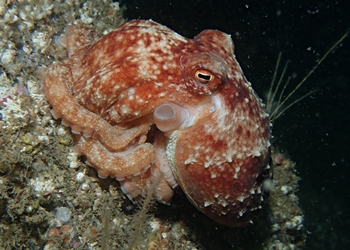
![]() Zirrenkrake oder Kleiner Octopus (Eledone cirrhosa): Pembrokeshire, Wales, UK. Bild: Phil Newman (iNaturalist) |
| Teil 1 | Teil 2 | Teil 3 | Teil 4 |
|---|---|---|---|
In Arbeit
|
| Ikegami, S. et al. (2026): "Earliest octopuses were giant top predators in Cretaceous oceans". Science 392 (6796), S. 406-410. (Abstract, abgerufen: 17.05.2026). | |
|
|
Dr.
Polaris:
"Cretaceous
Kraken? Nanaimoteuthis, The Largest Octopus To Ever Live".
( |
|
|
| Merkur.de: "Wir beginnen gerade erst zu sehen" - Forscher entdecken Urzeitmonster aus dem Meer. (Abgerufen: 17.05.2026). |
(vgl. Erdzeitalter)
PBS Eons:
How the
Squid Lost Its Shell. (
YouTube Video, abgerufen: 09.05.2026).
https://www.merkur.de/wissen/meer-wir-beginnen-gerade-erst-zu-sehen-forscher-entdecken-urzeitmonster-aus-dem-zr-94289627.html
Extinct Zoo:
When
Krakens Were Real. (
YouTube Video, abgerufen: 14.05.2026).
> Beyond the Blue: Why Are Prehistoric Cephalopods So Much More Terrifying Than Modern Ones? YouTube
Good evidence exists for the appearance of gastropods (e.g., Aldanella),
cephalopods (e.g., Plectronoceras) and bivalves (Pojetaia, Fordilla) towards the
middle of the Cambrian period, c. 500 million years ago, though arguably each of
these may belong only to the stem lineage of their respective classes.[72]
Budd GE, Jensen S (May 2000). "A critical reappraisal of the fossil record
of the bilaterian phyla". Biol Rev Camb Philos Soc. 75 (2) S000632310000548X:
253–95. doi:10.1111/j.1469-185X.1999.tb00046.x. PMID 10881389.
In Arbeit
In Arbeit
In Arbeit
In Arbeit
Letzte Änderung: 23.05.2026 (Robert Nordsieck).